
Vitiligo: Which Treatments Actually Help — and What to Be Cautious Of
If you have vitiligo, you have probably encountered two kinds of stories. The first is the discouraging one: that nothing can be done, and the white patches are simply something to live with. The second is the opposite — the miracle cream, the herbal remedy, or the supplement that promises to restore your pigment within weeks.
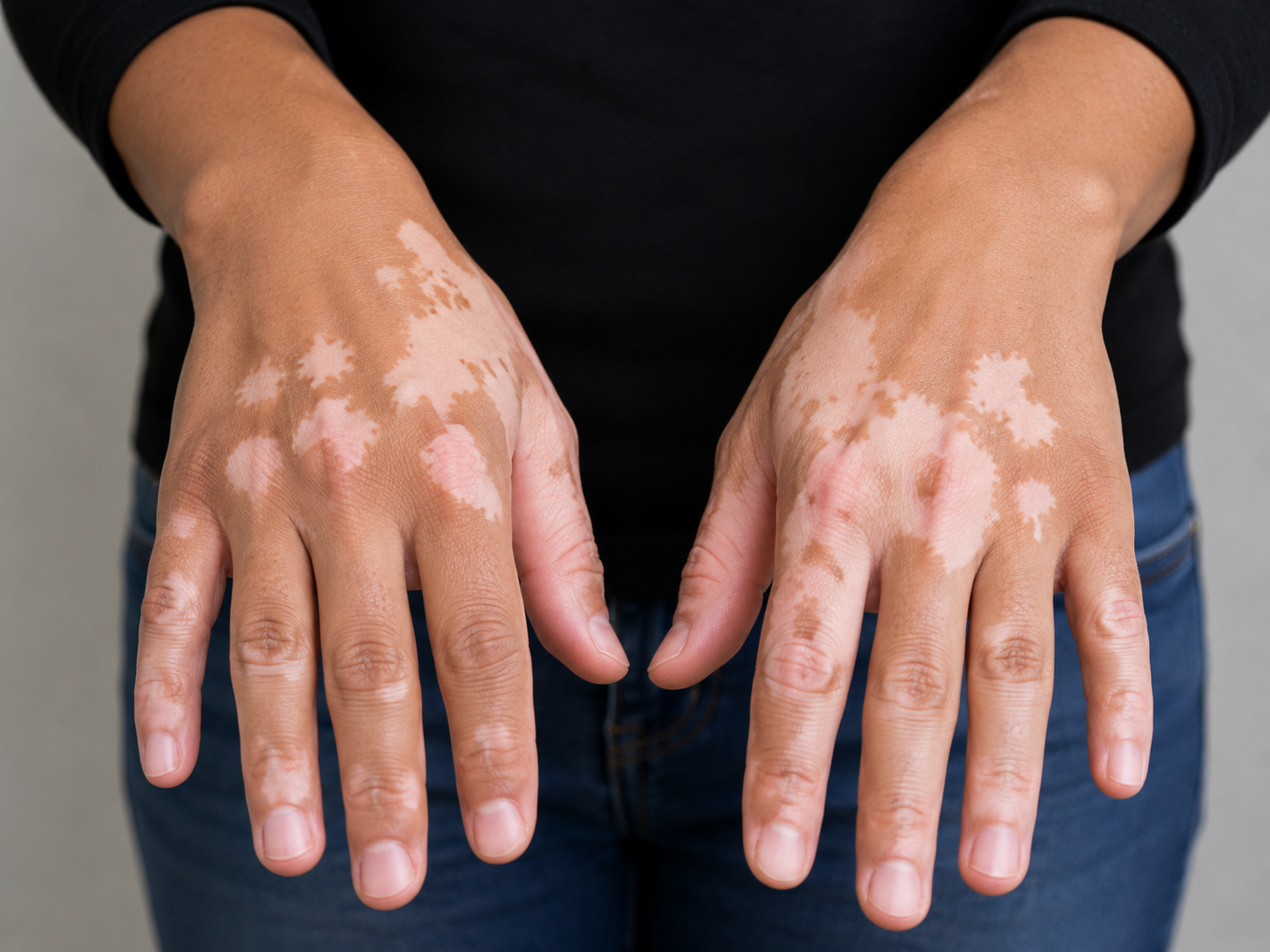
Vitiligo of the hands
Neither is true. Vitiligo cannot always be cured, but it can frequently be stabilised and, in many patients, meaningfully repigmented. The catch is that this only happens with treatments that have real evidence behind them, applied consistently and with realistic expectations. In this post I want to separate what actually helps from what deserves caution.
A brief recap: what vitiligo is
Vitiligo is an autoimmune condition in which the immune system mistakenly attacks the melanocytes — the cells that give skin its colour. As these cells are lost, well-defined, milky-white patches appear, often on the face, hands, and body folds. It is not contagious, and it is not caused by anything you have done. I cover the types of vitiligo, the diagnostic process, and the full range of treatment options on my dedicated vitiligo treatment page; here I want to focus on the practical question patients ask me most often: what is actually worth doing?
What the evidence supports
Topical anti-inflammatory treatment. For limited vitiligo, topical corticosteroids and topical calcineurin inhibitors (tacrolimus and pimecrolimus) remain the foundation of care. They calm the immune attack on the pigment cells and encourage repigmentation, and the calcineurin inhibitors are especially useful on the face and around the eyes, where long-term steroids would thin the skin.
Narrowband UVB phototherapy. For more widespread vitiligo, supervised narrowband UVB is the best-established treatment we have. Delivered in carefully measured doses over a course of months, it produces gradual, worthwhile repigmentation in many patients — and combining it with topical treatment tends to work better than either alone.
Newer targeted therapy. Topical JAK-inhibitor treatment (ruxolitinib cream) has been approved internationally for non-segmental vitiligo and is a genuine advance for selected patients. Availability and cost in South Africa are still evolving.
Surgical repigmentation. For vitiligo that has been stable for some time — particularly the segmental type — melanocyte transplantation and grafting techniques can restore pigment to patches that have not responded to medical treatment. These are reserved for carefully selected cases.
Camouflage and sun protection. Medical camouflage is not a consolation prize; it is a legitimate, evidence-supported part of care that can make patches far less noticeable while other treatment takes effect. Diligent sun protection matters too — it protects depigmented skin that burns easily and reduces the contrast that makes patches stand out.
What to be cautious of
Miracle cures. There is no shortage of creams, herbal preparations, and supplements sold online with dramatic before-and-after photographs. None has credible evidence for repigmenting vitiligo. The cost is not only financial — months spent on an ineffective remedy is time the condition may use to spread.
Deliberate sun exposure and sunbeds. It seems intuitive that sunlight should help, since medical phototherapy uses ultraviolet light. But the two are very different. Phototherapy delivers one precise wavelength in measured, supervised doses. Unprotected sun exposure burns depigmented skin quickly, and sunburn can do real damage beyond the burn itself: skin injury can trigger new vitiligo patches at the site, a response called the Koebner phenomenon.
Unregulated products bought informally. Some preparations sold outside pharmacies contain potent steroids or other undisclosed ingredients. On vitiligo-affected skin these can cause thinning, pigment changes in the surrounding skin, and other harm. If you are unsure what a product contains, that is reason enough not to use it.
Waiting too long. Repigmentation is most achievable when treatment starts before patches become long-standing, and rapidly spreading vitiligo can often be slowed or halted if it is treated during the active phase. Delay narrows the options.
Treating the skin and ignoring the rest. Vitiligo is associated with other autoimmune conditions, most importantly thyroid disease. A treatment plan that never includes screening for these is incomplete, which is why blood tests are part of my standard assessment.
When to see a dermatologist
Any new white patch deserves a proper diagnosis, because not everything that looks like vitiligo is vitiligo — fungal infections, post-inflammatory pigment loss, and several other conditions can mimic it. A specialist assessment, including sometimes examination under a Wood's lamp, establishes the diagnosis, gauges how active the condition is, and allows treatment to be chosen deliberately rather than by trial and error. If your vitiligo is spreading visibly, I would encourage you to be seen promptly — stabilising active disease is one of the situations where timing genuinely matters.
The bottom line
Vitiligo treatment is a steady process measured in months, not weeks, and honest expectations are part of good care. But "incurable" has never meant "untreatable", and the options available today are better than they have ever been.
I see patients with vitiligo at Panorama Dermatology Clinic in Panorama, serving Cape Town's northern suburbs including Durbanville, Bellville, Brackenfell, Parow, and Goodwood. To arrange an assessment, call 021 911 5470, send a WhatsApp to 079 321 1973, or book a consultation online.
Dr Jean Louw is a specialist dermatologist (FC Derm (SA), MMed Dermatology, UK CCST) with over 25 years of experience in medical, surgical, and cosmetic dermatology.
