
Psoriasis Treatment in Cape Town: A Specialist Dermatologist's Guide
If you or someone you care about lives with psoriasis, you know how much this condition can affect daily life. The persistent red, scaly patches, the itching, and the impact on confidence and comfort — psoriasis is more than a skin problem. It is a chronic inflammatory condition that deserves specialist attention and a well-considered treatment plan.
At Panorama Dermatology Clinic in Cape Town, I treat patients with all types and severities of psoriasis. In this guide, I want to share what you should know about psoriasis, the treatment options available, and how a specialist dermatologist can help you achieve better long-term control.
What Is Psoriasis?
Psoriasis is a chronic immune-mediated skin condition in which the body's immune system causes skin cells to turn over far more rapidly than normal. Instead of the usual four-week cycle, new skin cells push to the surface in just a few days, building up into the thick, scaly patches that characterise the condition.
Psoriasis affects roughly 2% of the population and can begin at any age, though it most commonly appears between the ages of 20 and 30 or between 50 and 60. It is not contagious. It tends to run in families, and environmental triggers — including stress, infections, certain medications, and skin injuries — can cause flare-ups.
Types of Psoriasis
There are several types of psoriasis, and a correct diagnosis is essential for choosing the right treatment approach.
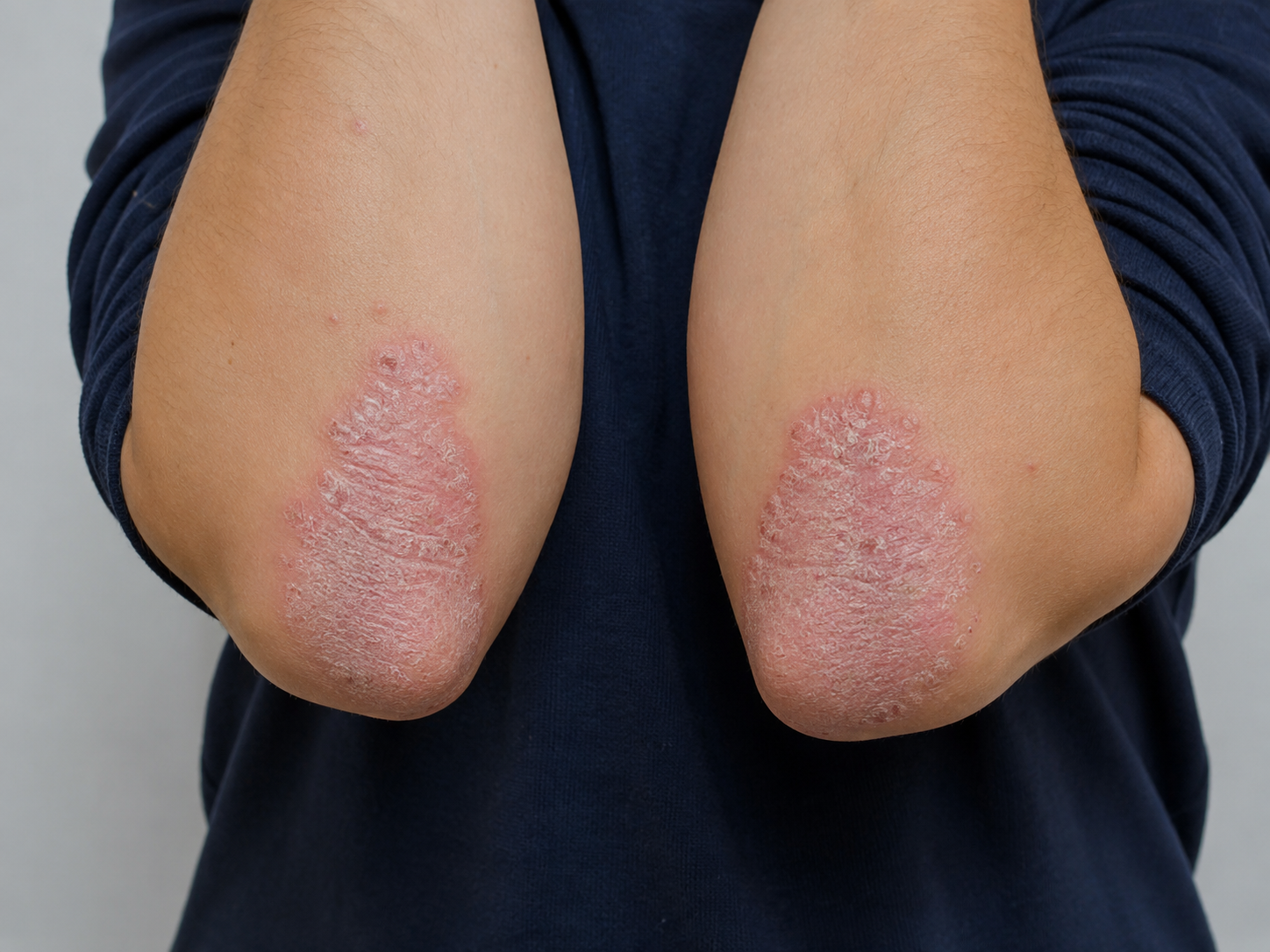
Plaque psoriasis is the most common form, accounting for about 90% of cases. It presents as well-defined red patches covered with silvery-white scales, most often on the elbows, knees, lower back, and scalp.
Guttate psoriasis typically appears as many small, drop-shaped patches across the trunk and limbs. It often follows a streptococcal throat infection, particularly in children and younger adults, and may resolve on its own over several months.
Scalp psoriasis can range from mild scaling to thick, crusted plaques covering the entire scalp. It often extends beyond the hairline and can cause significant itching and discomfort.
Flexural (inverse) psoriasis affects skin folds such as the armpits, groin, and under the breasts. It appears as smooth, red patches without the typical scaling, and is often aggravated by friction and moisture.
Pustular psoriasis presents with small, pus-filled blisters on inflamed skin. It may be localised to the palms and soles or, in rare cases, affect the entire body and require urgent medical attention.
Nail psoriasis causes pitting, discolouration, thickening, and sometimes separation of the nail from the nail bed. It is more common in patients who also have psoriatic arthritis.
Erythrodermic psoriasis is a rare but serious form in which widespread redness and shedding of skin affects most of the body surface. It is considered a medical emergency and requires immediate specialist care.
Psoriasis Is More Than Skin Deep
It is increasingly recognised that psoriasis is a systemic condition with implications beyond the skin. Patients with psoriasis have a higher risk of developing metabolic syndrome — a cluster of conditions that includes high blood pressure, elevated cholesterol, insulin resistance, and obesity — as well as cardiovascular disease.
Up to 30% of patients with psoriasis may develop psoriatic arthritis, which causes pain, stiffness, and swelling in the joints. Early detection and management of these associated conditions is an important part of comprehensive psoriasis care.
This is one of the reasons I believe psoriasis should be managed by a specialist dermatologist who can assess the full picture, not just the skin.
How I Treat Psoriasis at Panorama Dermatology Clinic
There is currently no cure for psoriasis, but with the right treatment plan, most patients can achieve significant improvement and long periods of remission. The goal is always to reduce the severity of symptoms, protect your quality of life, and minimise the long-term risks associated with the condition.
Treatment is tailored to each patient depending on the type and extent of psoriasis, its impact on daily life, any associated conditions, and the patient's treatment history.
Topical Treatments
For mild psoriasis affecting less than 10% of the body surface, topical treatments are usually the first step. These include corticosteroid creams and ointments, vitamin D analogues (such as calcipotriol), coal tar preparations, and calcineurin inhibitors. Keeping the skin well moisturised is also essential — regular use of emollients helps soften scales, reduce cracking, and ease discomfort.
Phototherapy (Light Therapy)
For moderate psoriasis or cases that do not respond adequately to topical treatments alone, phototherapy is an effective and well-established next step. At Panorama Dermatology Clinic, I offer phototherapy as part of our medical dermatology services.
Narrowband UVB phototherapy involves controlled exposure to a specific wavelength of ultraviolet light that slows the rapid turnover of skin cells. Treatment sessions are typically short, and a course of phototherapy usually involves two to three sessions per week over several weeks. Many patients experience significant clearing of their psoriasis with phototherapy, and it avoids the systemic side effects of oral medications.
Phototherapy is particularly useful for patients with widespread psoriasis or for those who prefer a treatment that does not involve taking medication. It can also be used alongside topical treatments for enhanced results.
Systemic Treatments
For moderate-to-severe psoriasis that does not respond to topical therapy and phototherapy, systemic medications may be appropriate. Traditional systemic options include methotrexate, ciclosporin, and acitretin. Each has a well-established evidence base, and the choice depends on the individual patient's circumstances, other health conditions, and treatment goals.
In recent years, biologic therapies have transformed the treatment of severe psoriasis. These targeted medications work by blocking specific parts of the immune system that drive psoriasis. While I do not prescribe all biologics directly, I work closely with patients to ensure they are referred appropriately and receive the most suitable advanced therapy when needed.
When Should You See a Dermatologist for Psoriasis?
Many patients with psoriasis manage for years with over-the-counter creams or GP-prescribed treatments before seeing a specialist. I would encourage you to consult a dermatologist if:
Your psoriasis is not well controlled with current treatment
You have psoriasis affecting your scalp, nails, face, or genital area
Your psoriasis is widespread or getting worse
You are experiencing joint pain or stiffness alongside your skin symptoms
Your condition is affecting your confidence, sleep, or daily activities
You are interested in phototherapy or systemic treatment options
A specialist can accurately classify your psoriasis, assess its severity using validated scoring tools, check for associated conditions, and build a long-term management plan that evolves with your needs.
Living with Psoriasis: Practical Tips
While professional treatment is the foundation of good psoriasis management, there are practical steps that can help between appointments:
Moisturise daily with a fragrance-free emollient to reduce dryness and scaling
Avoid picking or scratching plaques, as this can trigger new patches (the Koebner phenomenon)
Use lukewarm water for bathing rather than hot water, which can worsen itching
Manage stress where possible, as emotional stress is a well-known psoriasis trigger
Avoid smoking and limit alcohol intake, both of which are associated with more severe psoriasis
Let your dermatologist know about all medications you take, as some drugs (including beta-blockers, lithium, and antimalarials) can worsen psoriasis
Protect your skin from injury and sunburn, which can trigger flare-ups
Book a Psoriasis Consultation in Cape Town
If you are living with psoriasis and looking for specialist care in Cape Town's northern suburbs, I invite you to book a consultation at Panorama Dermatology Clinic. Our practice is conveniently located in Panorama, with easy access from Durbanville, Bellville, Brackenfell, Parow, Goodwood, and the greater Tygerberg area.
With over 25 years of dermatology experience and internationally recognised specialist qualifications, I am committed to providing evidence-based, personalised psoriasis care in a calm and supportive environment.
Call 021 911 5470 or WhatsApp 079 321 1973 to book your appointment.