
Skin Cancer Screening and Mole Checks in Cape Town
South Africa has one of the highest rates of skin cancer in the world. Our high levels of year-round ultraviolet radiation, combined with a large fair-skinned population and an outdoor lifestyle, mean that skin cancer is something every Capetonian should take seriously — regardless of age or skin type.
The reassuring news is that when skin cancer is detected early, it is almost always treatable, and often completely curable. A regular skin cancer screening with a specialist dermatologist is one of the simplest and most effective steps you can take to protect your long-term health.
At Panorama Dermatology Clinic, I personally perform every skin cancer screening and mole assessment. With over 25 years of specialist experience, my goal is to give you a clear, calm, and thorough assessment — and peace of mind.
Why Skin Cancer Screening Matters
Most skin cancers develop in areas exposed to the sun, but they can appear anywhere on the body — including areas you cannot easily see yourself. Many skin cancers are painless in their early stages and are easy to dismiss as a harmless mark or mole.
Early detection makes an enormous difference. A basal cell carcinoma found early can often be removed with a minor procedure. A melanoma found early has an excellent prognosis — but the same melanoma left for a year or two can become far more serious. The earlier we identify a concerning lesion, the simpler the treatment and the better the outcome.
Understanding the Main Types of Skin Cancer
Basal cell carcinoma (BCC) is the most common form of skin cancer. It tends to grow slowly and rarely spreads to other parts of the body, but if left untreated it can cause significant local damage. BCCs often appear as a pearly bump, a persistent non-healing sore, or a flat scaly patch.
Squamous cell carcinoma (SCC) is the second most common skin cancer. It can grow more quickly than a BCC and, in some cases, can spread if neglected. SCCs often appear as a firm, scaly or crusted lump, sometimes tender to the touch. They frequently develop from pre-cancerous sun damage known as solar (actinic) keratoses.
Melanoma is less common but more serious, because it can spread to other organs if not caught early. Melanoma can develop within an existing mole or appear as a new pigmented spot. This is why any changing, unusual, or new mole deserves a professional assessment.
The ABCDE Rule: What to Look For
Between professional skin checks, it is worth knowing the warning signs. The ABCDE rule is a helpful guide for assessing a mole:
A — Asymmetry: one half does not match the other
B — Border: edges are irregular, blurred, or notched
C — Colour: more than one colour, or uneven colour
D — Diameter: larger than about 6mm (the size of a pencil eraser)
E — Evolving: changing in size, shape, colour, or sensation
You should also pay attention to any spot that bleeds, itches, or does not heal. If you notice any of these signs, please book an assessment — it is always better to have it checked.
What a Skin Cancer Screening Involves
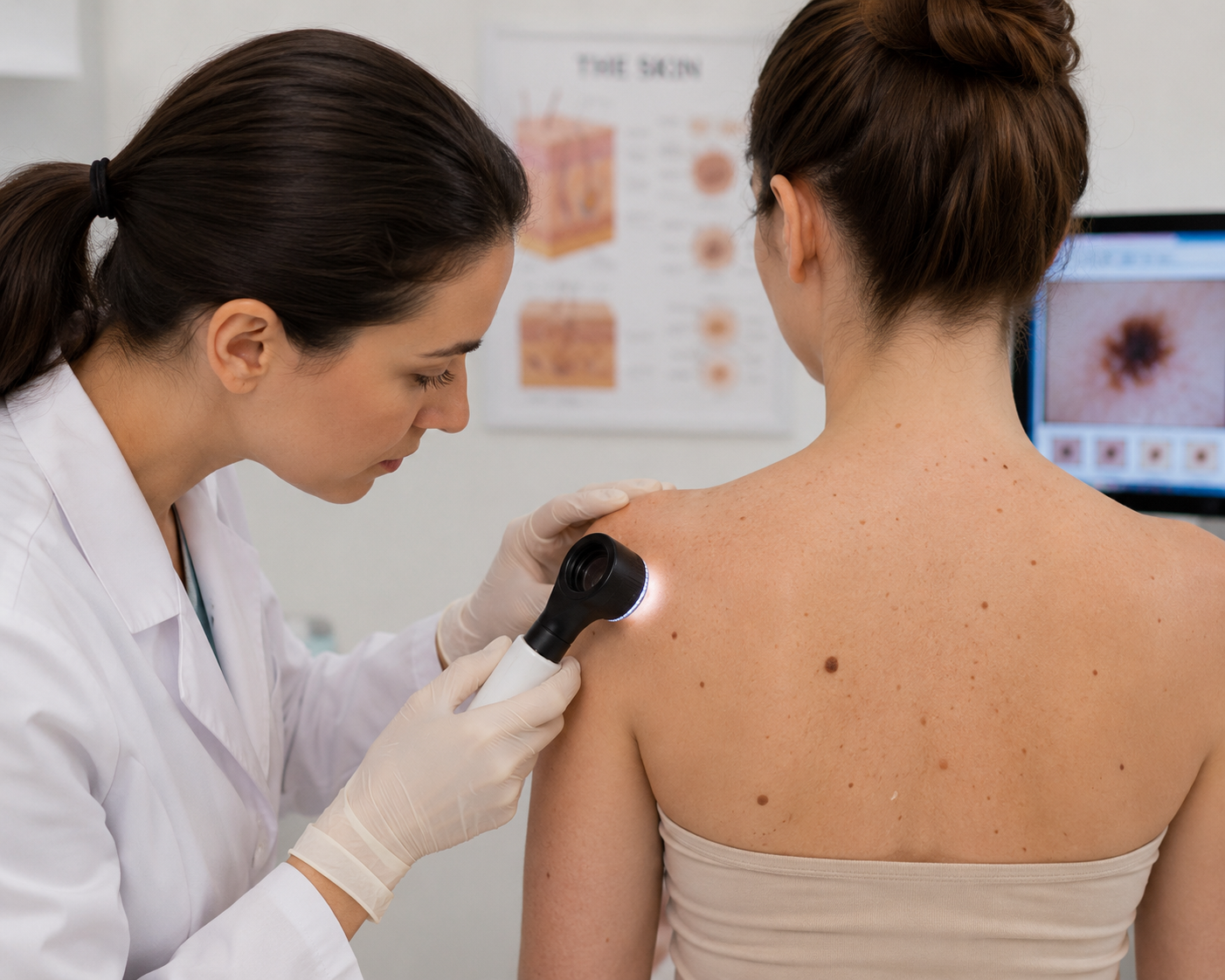
A full skin cancer screening at our Panorama clinic is straightforward and comfortable. It involves a careful, systematic examination of your skin from head to toe, including areas that are easy to overlook such as the scalp, behind the ears, the soles of the feet, and between the toes.
For any mole or lesion that needs a closer look, I use dermoscopy — a specialised magnifying instrument with polarised light that reveals structures and patterns invisible to the naked eye. Dermoscopy significantly improves diagnostic accuracy and often allows me to reassure patients that a mole is harmless, without the need for any further procedure.
If Something Suspicious Is Found
If I identify a lesion that needs further investigation, the next step is usually a skin biopsy — taking a small sample of the lesion for laboratory analysis — or a complete excision of the lesion. Both are minor procedures performed under local anaesthetic in our rooms. You can read more about these on our surgical dermatology page.
For certain pre-cancerous lesions and superficial skin cancers, other treatment options such as cryotherapy or photodynamic therapy may be appropriate. I will always explain the findings clearly, talk you through the options, and make sure you understand the plan before anything is done.
Who Should Have a Skin Check, and How Often?
I would recommend a professional skin cancer screening if you:
Have fair skin, light eyes, or a tendency to burn rather than tan
Have had significant sun exposure or sunburn, especially in childhood
Have a large number of moles, or moles that are unusual in appearance
Have a personal or family history of skin cancer or melanoma
Have noticed a new, changing, or non-healing spot
Work outdoors or spend a lot of time outdoors
For most adults, an annual full-body skin examination is sensible. If you have a history of skin cancer or are considered higher risk, I may recommend more frequent checks. And if you ever notice a concerning change between appointments, do not wait — book an earlier visit.
Skin Cancer Screening for Patients Across Cape Town's Northern Suburbs
Panorama Dermatology Clinic is located at 46 Hennie Winterbach Street in Panorama, with easy access from the N1 and Voortrekker Road. We welcome patients for skin checks and mole assessments from Durbanville, Bellville, Brackenfell, Kraaifontein, Parow, Goodwood, Tygerberg, and the greater Cape Town area.
A skin check takes very little time and could not be more worthwhile. Call us on 021 911 5470 or WhatsApp 079 321 1973 to book your skin cancer screening with Dr Jean Louw.
Frequently Asked Questions
Q: Does a skin cancer screening hurt? No. A skin cancer screening is a visual examination of your skin, including assessment with a dermatoscope. It is completely painless. If a mole or lesion needs a biopsy or removal, that minor procedure is done under local anaesthetic, so you should feel little to no discomfort.
Q: How long does a full skin check take? A thorough full-body skin examination usually takes around 15 to 30 minutes, depending on the number of moles and lesions that need closer assessment.
Q: Do I need a referral to book a skin check? No referral is needed to book a consultation. However, if you are claiming from a medical aid, it is worth confirming your benefits and whether a referral affects your cover.
Q: Will my medical aid cover skin cancer screening? Cover varies between schemes and plans. The investigation and treatment of suspected skin cancer is generally regarded as medically necessary, but routine screening may be handled differently. We recommend checking with your medical aid before your appointment, and our practice can provide procedure codes if needed.
Q: I have a mole I am worried about — should I wait for an annual check? No. Any mole or spot that is new, changing, bleeding, itching, or not healing should be assessed promptly rather than waiting for a routine appointment. Early assessment gives the best possible outcome.