
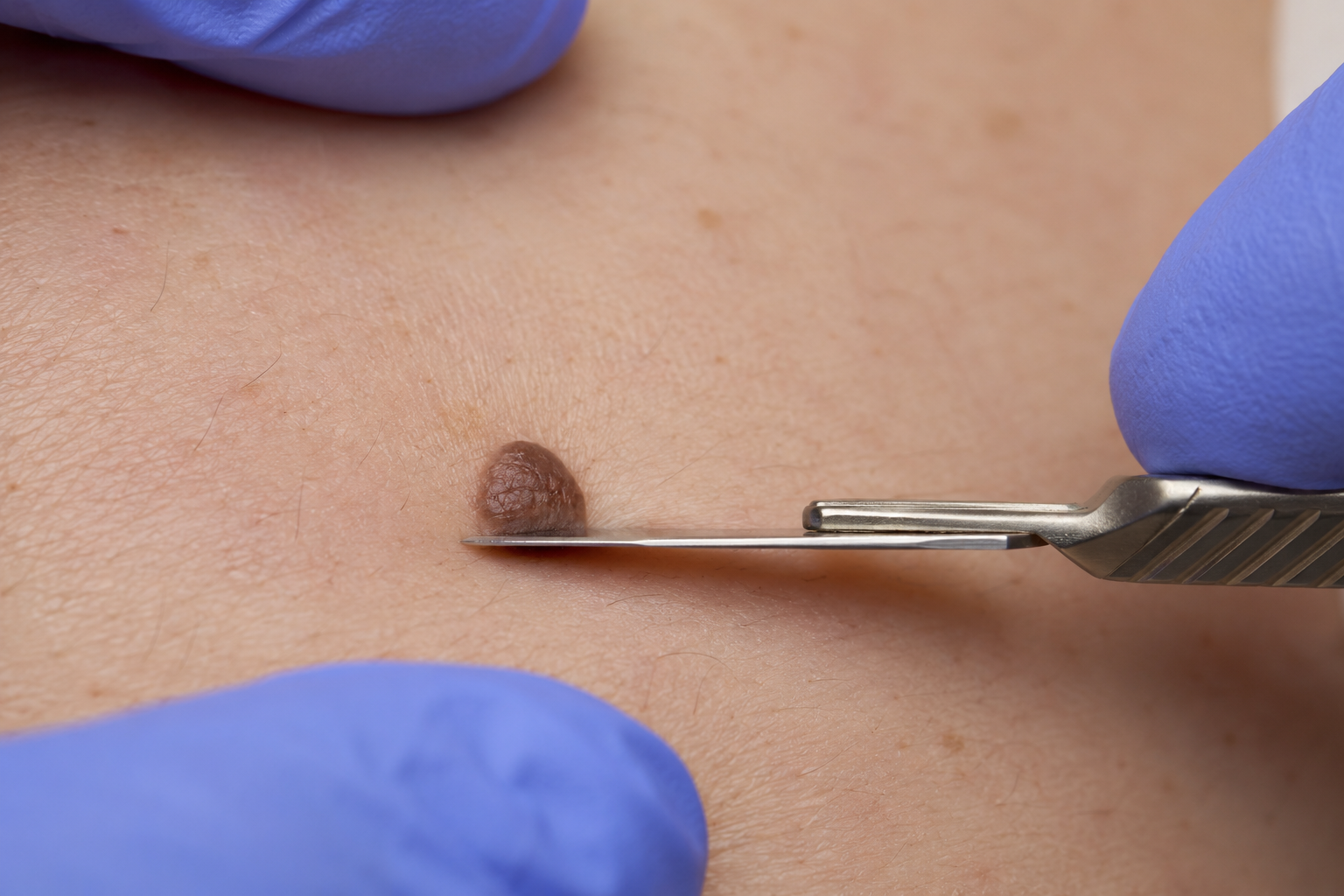
Specialist mole removal
Having a mole removed is one of the most common reasons patients come to see me. A mole removal is rarely just a cosmetic step — it is a small surgical procedure, and what happens to the mole afterwards is every bit as important as how it is taken off.
At Panorama Dermatology Clinic I remove moles surgically, under local anesthetic, as a planned day procedure, and I send every mole I remove for laboratory analysis. That single principle — that a removed mole is always examined under the microscope — is the most important safeguard in the whole process, and it is simply built into the way I work.
Why a mole might need to be removed
There are three broad reasons to remove a mole, and I'll explain which one applies to yours.
The first is medical concern. If a mole is changing, growing, bleeding, itching, or simply looks different from your others, it needs to be assessed and, in many cases, removed so that it can be tested. This is the situation where removal is not optional — it is how we rule out or catch a skin cancer such as melanoma early, when it is most treatable.
The second is irritation. A mole that catches on clothing, a bra strap, a razor or a comb, or that is repeatedly knocked, can be uncomfortable and is reasonable to remove for comfort alone.
The third is cosmetic. Some patients simply dislike the appearance of a mole, particularly on the face. That is a perfectly valid reason to remove one, and a mole removed for cosmetic reasons is still examined properly and sent to the laboratory afterwards, exactly as any other would be.
A mole should be assessed before it is removed
Before removing any mole, I examine it carefully, usually with a dermatoscope — a specialized magnifying device that lets me see structures within the mole that are invisible to the naked eye. This matters because the goal is never simply to make a mole disappear; it is to remove it in the right way, using the right technique, with the correct margin if there is any suspicion.
If you are unsure whether a mole is safe in the first place, or you have several moles you would like reviewed rather than one you want removed, a skin cancer screening and mole check is the better starting point. I will guide you to whichever is appropriate for you.
How I remove moles
The right method depends on the type of mole, where it is, and whether there is any concern about it. I will explain which approach I recommend for your mole and why.
Surgical excision. For any mole that is flat, pigmented, or in any way suspicious, I remove the full thickness of the mole with a small margin of surrounding skin and close the wound with sutures. This is the gold-standard method when an accurate laboratory diagnosis matters, because it removes the whole lesion intact for examination.
Shave excision. For raised, clearly benign moles — the soft, dome-shaped kind that catch and irritate — a shave excision removes the mole flush with the skin under local anesthetic, usually without stitches. It heals well and leaves a flat mark rather than a line. I reserve this for moles I am confident are harmless, and the tissue is still sent for analysis.
Whichever technique is used, the procedure is done under local anesthetic in the rooms, you are awake and comfortable throughout, and you go home the same day.
Every mole is sent for histology
No matter why a mole is being removed — medical, irritation or purely cosmetic — I send it to a pathology laboratory to be examined under the microscope. Sending every mole for testing as a matter of routine means nothing is ever overlooked, and it is something I do for every removal.
Scarring and the cosmetic result
Any time skin is removed, it leaves some kind of mark. My aim is to keep it as small and discreet as possible.
Mole removal for patients across Cape Town's Northern Suburbs
I see patients for mole removal at Panorama Dermatology Clinic, conveniently located at 46 Hennie Winterbach Street in Panorama. I welcome patients from Panorama, Durbanville, Bellville, Brackenfell, Kraaifontein, Parow, Goodwood and the wider Northern Suburbs, as well as from across greater Cape Town.
Frequently asked questions
What happens to a mole after it is removed? Every mole I remove is sent to a pathology laboratory to be examined under the microscope. This confirms exactly what the mole was and ensures that any unexpected early change is identified and acted on. It is a routine part of every removal I perform, whatever the reason for it.
Does mole removal hurt? The procedure is done under local anesthetic, so you feel a brief sting as the area is numbed and then little more than pressure. It is a comfortable, planned day procedure and you go home afterwards.
Will mole removal leave a scar? Any removal leaves some mark. A specialist chooses the method and closure that give the best result for the area involved and places the wound to heal as discreetly as possible. I will explain the realistic outcome for your mole before we begin.
Is every mole tested after removal? Yes. I send every mole I remove for histology, regardless of whether it was removed for medical, comfort or cosmetic reasons. It is the most important safeguard in the whole process.
Can a mole grow back after removal? A fully excised mole should not return. A small amount of pigment can sometimes reappear after a shave removal of a benign mole; if that happens it can be reviewed and, if needed, fully excised. Any mole that recurs should always be re-examined.
Does medical aid cover mole removal? Removal for a medical reason — a changing or suspicious mole — is usually claimable, while purely cosmetic removal generally is not. Cover varies by scheme and plan, and I can go through the likely costs with you before anything is done.
Book a mole removal consultation in Cape Town
If you have a mole you would like removed, or one you are worried about, I would be glad to examine it and talk you through the right approach.
Phone: 021 911 5470 WhatsApp: 079 321 1973