
Hair Loss: When Should You See a Dermatologist?
Hair loss is one of the most common concerns I see in my practice, and one of the most distressing. Patients often tell me they waited months — sometimes years — before seeking help, either because they hoped it would resolve on its own or because they assumed nothing could be done.
Both assumptions can be costly. Some forms of hair loss do settle by themselves, but others are progressive, and a few cause permanent, irreversible loss if treatment is delayed. The good news is that most causes of hair loss can be diagnosed accurately and managed effectively — provided the diagnosis is made early and correctly.
Not all hair loss is the same
The first thing to understand is that "hair loss" is not a single condition. Broadly, patients present in one of three ways:
Gradual thinning. Hair slowly becomes finer and less dense, usually over years. In men this typically affects the hairline and crown; in women it tends to show as widening of the central parting while the front hairline is preserved.
Sudden shedding. Large amounts of hair come out when washing or brushing, often quite dramatically, usually starting two to four months after a trigger such as serious illness, surgery, childbirth, rapid weight loss, or significant emotional stress.
Patches or scarring. Well-defined bald patches, or areas where the scalp looks shiny and smooth, sometimes with redness, scaling, itching, or burning.
These patterns point to very different diagnoses, and they carry very different levels of urgency.
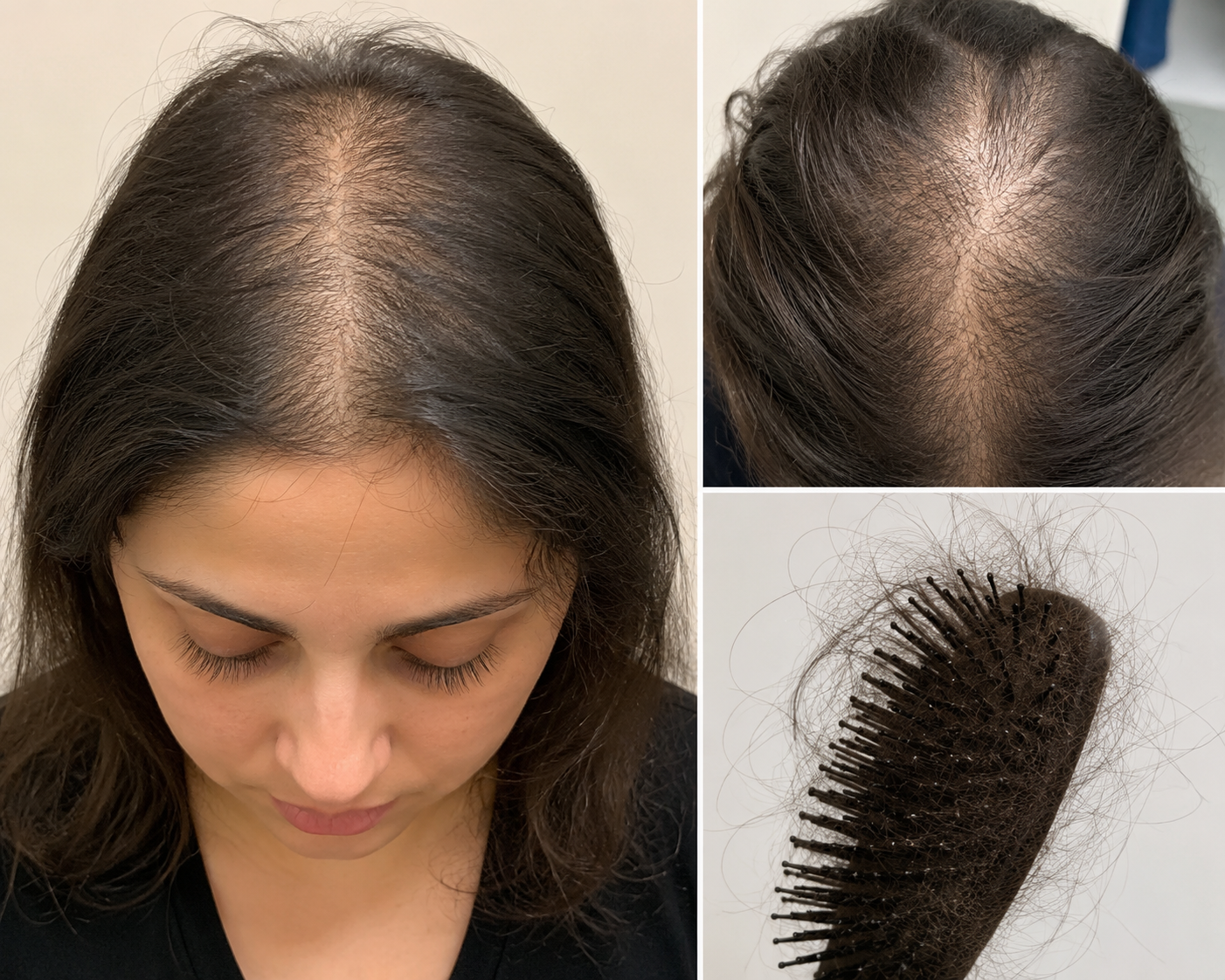
Female patient with Telogen Effluvium
The common causes
Androgenetic alopecia (male- and female-pattern hair loss) is by far the most common cause. It is driven by genetic sensitivity of the hair follicles to androgens and affects the majority of men and a large proportion of women at some point in life. It is gradual and progressive, but it responds well to treatment — especially when started early.
Telogen effluvium is the sudden shedding described above. A physiological stressor pushes a large number of follicles into their resting phase at the same time, and the hairs are shed a few months later. It is usually self-limiting once the trigger has passed, but it is important to exclude contributing factors such as iron deficiency, thyroid disease, and certain medications.
Alopecia areata is an autoimmune condition that causes well-defined round bald patches, and in severe cases can affect the whole scalp or body. It is unpredictable, but treatment options have improved considerably in recent years, including newer systemic therapies for extensive disease.
Traction alopecia results from prolonged tension on the hair from tight braids, weaves, extensions, or ponytails. It typically affects the hairline and temples. Caught early, it is fully reversible; left too long, the follicles are permanently lost.
Scarring (cicatricial) alopecias are a group of inflammatory conditions — including central centrifugal cicatricial alopecia, lichen planopilaris, and frontal fibrosing alopecia — in which the hair follicle is destroyed and replaced by scar tissue. These are the most urgent of all. Hair lost to scarring does not grow back, so the goal of treatment is to halt the process before more follicles are destroyed.
Red flags: when to seek help promptly
I would encourage you to see a dermatologist sooner rather than later if you notice any of the following:
Bald patches, however small
An itchy, burning, painful, or visibly inflamed scalp alongside hair loss
Areas where the scalp looks shiny, smooth, or scarred
A receding frontal hairline in a woman, or loss of eyebrow hair
Shedding that continues beyond about six months
Hair loss accompanied by other symptoms such as fatigue, weight change, or skin and nail changes
These features suggest a diagnosis that needs active treatment — and in the case of scarring alopecias, time genuinely matters.
How a dermatologist makes the diagnosis
An accurate diagnosis is the foundation of effective treatment. A specialist assessment typically includes a detailed history (including medication, diet, family history, and hair-care practices), a full examination of the scalp, hair, and nails, and trichoscopy — dermoscopic examination of the scalp, which often reveals the diagnosis without any invasive testing.
Where indicated, blood tests are used to check for iron deficiency, thyroid dysfunction, and hormonal factors. In selected cases, particularly where a scarring process is suspected, a small scalp biopsy gives a definitive answer.
What actually works
Treatment depends entirely on the diagnosis, which is why I am cautious about over-the-counter products promising universal results. Evidence-based options include topical minoxidil, oral therapies targeting the hormonal drivers of pattern hair loss, anti-inflammatory and immune-modulating treatment for alopecia areata and the scarring alopecias, and procedural options such as PRP combined with minoxidil, which I have written about previously.
Two principles apply across the board. First, start early: it is far easier to keep the hair you have than to regrow hair that has been lost. Second, be patient: hair grows slowly, and most treatments need three to six months before improvement is visible.
Book a hair loss consultation in Cape Town
If you are concerned about hair loss, a proper diagnosis is the most valuable first step. You can read more about the conditions I treat on my dedicated hair loss treatment page.
I personally manage every consultation at Panorama Dermatology Clinic, which serves Panorama and Cape Town's northern suburbs, including Durbanville, Bellville, Brackenfell, Parow, and Goodwood. To book a consultation, call 021 911 5470, send a WhatsApp to 079 321 1973, or book a consultation online.
Dr Jean Louw is a specialist dermatologist (FC Derm (SA), MMed Dermatology, UK CCST) with over 25 years of experience in medical, surgical, and cosmetic dermatology.
