
How to Choose a Dermatologist in Cape Town — and When You Actually Need One
Skin, hair, and nail problems are common, and most people are not sure who they are supposed to see about them. Should you start with your GP? Go straight to a dermatologist? Visit a skin clinic or a beauty salon? And once you have decided to see a dermatologist, how do you know you are choosing the right one?
These are reasonable questions, and patients ask me some version of them often. This is a short, practical guide to help you decide when a dermatologist is the right person to see, and what to look for when you choose one in Cape Town.
GP, dermatologist, or skin clinic — who does what
For many everyday skin complaints, your GP is a sensible first stop. Your GP can manage mild acne, common rashes, and minor infections, and will refer you on if something needs specialist attention.
A dermatologist is a medical specialist who has completed 4 years of additional training at an academic hospital, specifically in diseases of the skin, hair, and nails — after qualifying as a doctor. That extra training matters most when a diagnosis is uncertain, when a problem has not responded to first-line treatment, or when a condition needs ongoing specialist management, a procedure, or surgery.
A non-medical skin clinic or salon is a different thing again. Aesthetic therapists can offer helpful skincare and cosmetic treatments, but they are not qualified to diagnose disease, prescribe medication, or assess a worrying mole. If there is any question of an actual medical condition, that belongs with a doctor.
The simplest way to think about it: for a cosmetic touch-up, a salon may be fine; for anything that might be a medical problem, see a doctor — and for skin disease that is persistent, severe, or uncertain, see a dermatologist.
Signs it is worth seeing a dermatologist
You do not need to wait until a problem is severe. It is worth arranging to see a specialist if:
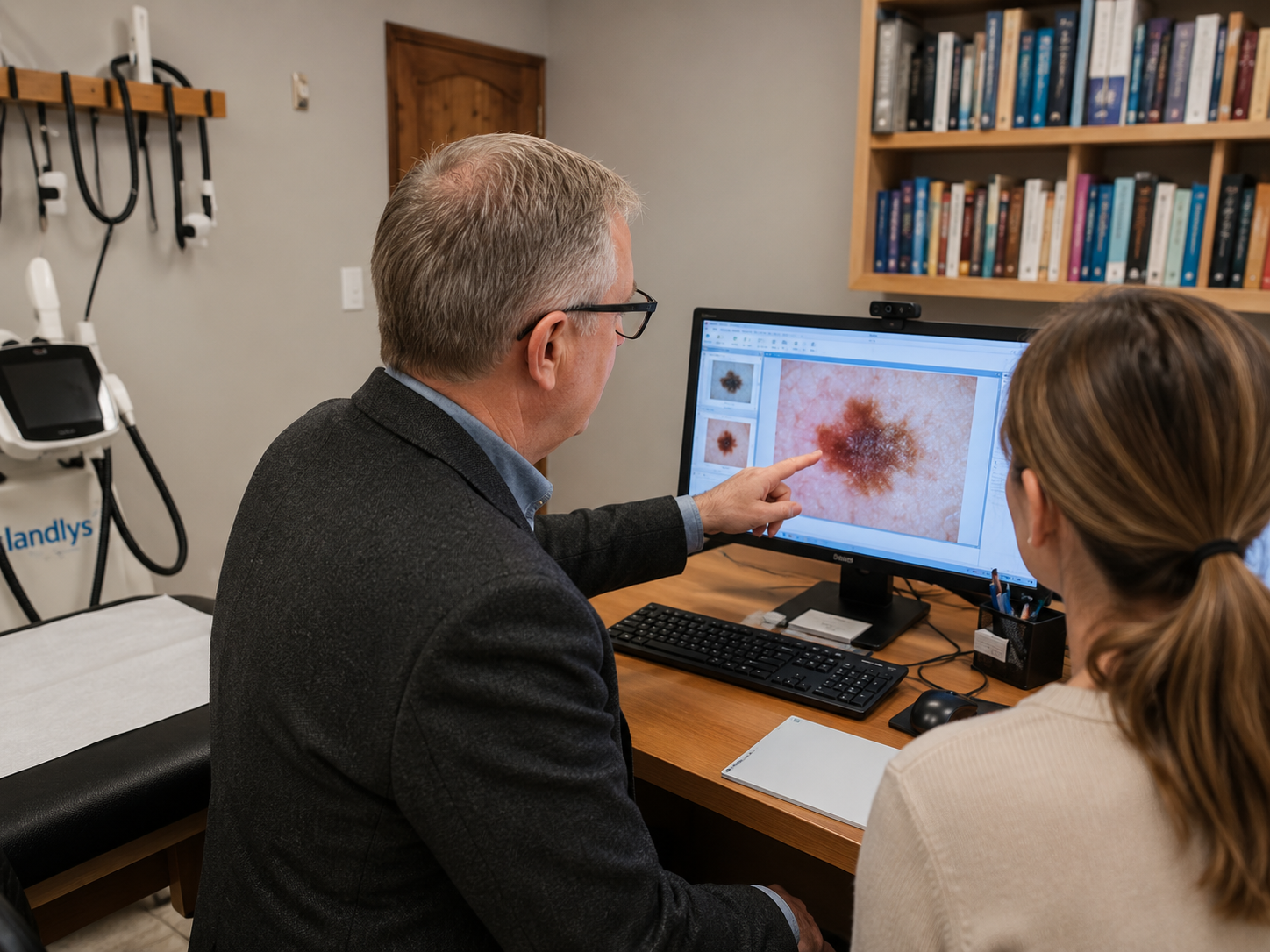
A mole or spot is changing — growing, changing colour or shape, bleeding, or simply new and different from your others. Changing lesions should always be checked, and prompt skin cancer screening is the single clearest reason not to delay.
A rash or skin condition is not settling with pharmacy treatments or a GP's first-line care, or it keeps coming back.
Acne is leaving marks or scars, or is not responding to over-the-counter products. Scarring is far easier to prevent than to treat later.
You are losing hair noticeably or rapidly. Some causes are reversible, but a few cause permanent loss if treatment is delayed, so early assessment is worthwhile.
The itch, discomfort, or appearance is affecting your sleep, work, or confidence. Quality of life is a legitimate reason to seek help, not an afterthought.
You have a long-term condition such as eczema, psoriasis, or rosacea that you would like managed properly rather than just patched over.
If you are unsure whether something qualifies, it is reasonable to have it looked at. A short consultation that ends in reassurance is a good outcome.
What to look for when choosing a dermatologist
Once you have decided to see a dermatologist, a few things are worth checking. These apply to any practice, not just mine.
Specialist registration. A registered specialist dermatologist in South Africa is registered as such with the Health Professions Council of South Africa (HPCSA), after completing accredited specialist training and the relevant qualifications — in South Africa, the FC Derm (SA) and/or an MMed in Dermatology. It is entirely fair to look them up. The title "dermatologist" should mean specialist training, not simply an interest in skin.
Scope of care. Dermatology spans three broad areas — medical dermatology (diagnosis and treatment of skin disease), surgical dermatology (skin cancer, biopsies, and minor skin surgery), and cosmetic dermatology. A practice that covers all three can manage a problem end to end rather than referring you on partway through.
An evidence-based, unhurried approach. Good dermatology is calm and methodical: a proper diagnosis first, then a treatment plan matched to the severity of the condition and explained clearly. Be cautious of anywhere that promises dramatic results or pushes expensive packages before a diagnosis has even been made.
Location and access. Practical things matter too — where the rooms are, how booking and follow-up work, and how easy it is to reach the practice for ongoing care.
A specialist-led practice in the northern suburbs
I am a specialist dermatologist with over 25 years of experience, and at Panorama Dermatology Clinic I personally manage every consultation, diagnosis, and treatment plan. You can read more about my qualifications and experience — including FC Derm (SA), MMed Dermatology, and a UK Certificate of Completion of Specialist Training.
The practice covers medical, surgical, and cosmetic dermatology under one roof, in our own rooms at 46 Hennie Winterbach Street in Panorama — easily reached from across Cape Town's northern suburbs, including Durbanville, Bellville, Brackenfell, Parow, and Goodwood.
To arrange an appointment, book a consultation at Panorama Dermatology Clinic. Call 021 911 5470 or WhatsApp 079 321 1973, and we will help you find a suitable time.
